Same data. Different metrics. Different verdicts.
INFO 3312 · Cornell University · Spring 2026
Who Is Responsible
for Climate Change?
The answer depends on how you measure it. This project walks through four empirically valid lenses — and four different verdicts.
“China is the world’s largest emitter.”
“But the US emits far more per person.”
“But the US caused the most damage historically.”
“But wealthy nations outsource their emissions.”
Every statement is backed by real data.
The choice of metric is never just technical — it is always also political.
Our World in Data — CO₂ Emissions dataset, 2024
50,000+ observations · 1750 to present · 79 variables
Seven countries
China · United States · India · Germany · UK · Russia · Japan
Chosen to represent every fault line in the debate: large vs. small, early vs. late industrializers, producers vs. consumers.
Why Closeread scrollytelling — not Shiny, not a dashboard?
These metrics are routinely encountered in isolation. A guided narrative forces readers to hold all four lenses simultaneously.
Same data. Four metrics. Four different countries held responsible.
Narrative architecture
We ordered the four lenses deliberately:
Total → Per capita → Cumulative → Consumption
Each lens exposes a blind spot in the previous one. By the time readers reach Lens 04, they have the context to see why consumption framing is so politically charged.
Form fits function
We chose Closeread scrollytelling over Shiny because interactivity without narrative guidance makes it harder to interpret data, not easier.
The scroll forces a reading order — and that order is the argument.
Two interactive elements added to engage the reader
Opening card reveal
Four lens cards appear one by one as readers scroll. Previews the structure, creates anticipation.
Verdict bar animation
In the conclusion, four bars fill left-to-right with staggered delays — drawing the eye sequentially through the final payoff.

Lens 01 · Total
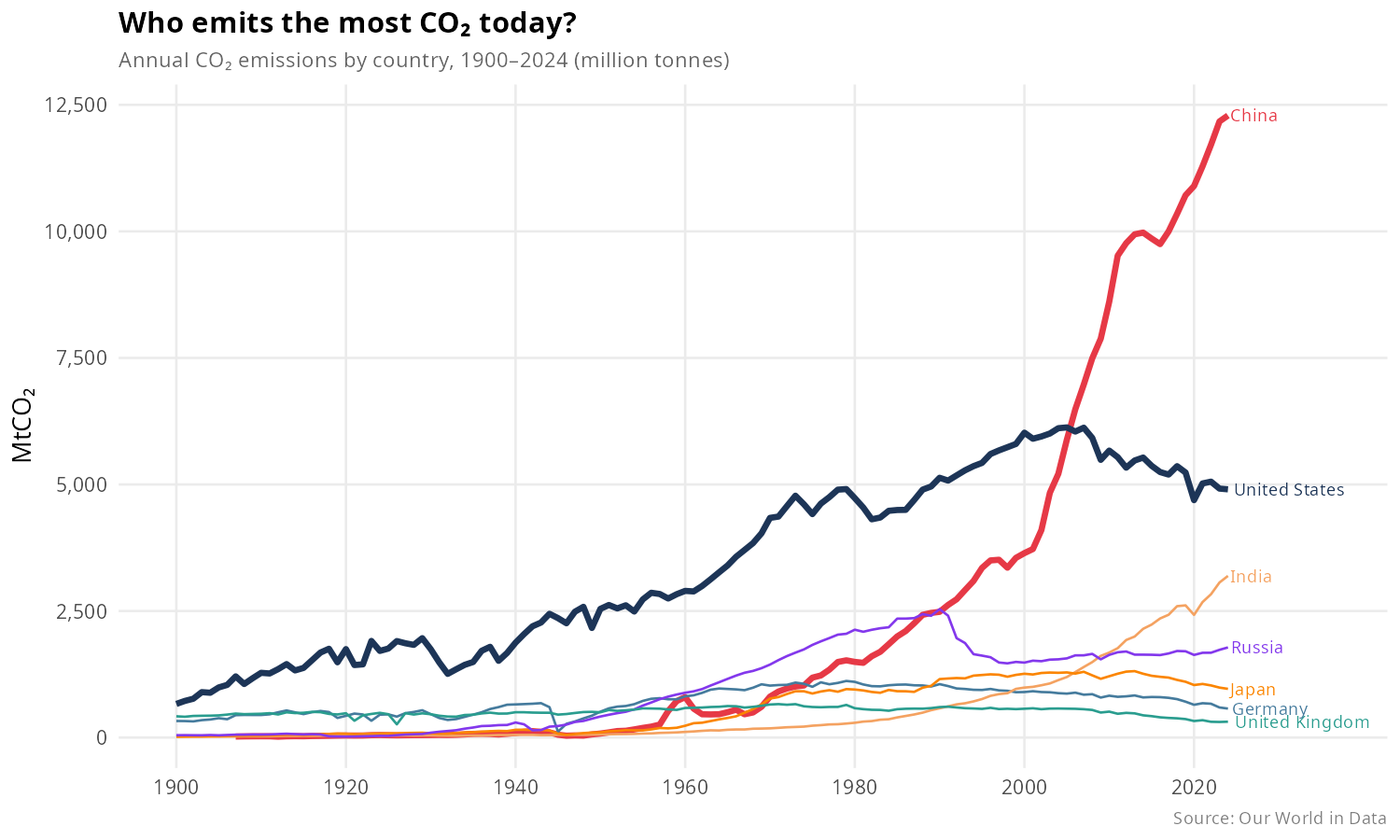
China surpassed the US around 2006 — but its output reflects manufacturing demand from wealthier nations, not domestic consumption.
Lens 02 · Per Capita
The US, Russia, and Germany are the real high emitters per person, reflecting car-dependent infrastructure and fossil-fuel grids.

Lens 03 · Cumulative
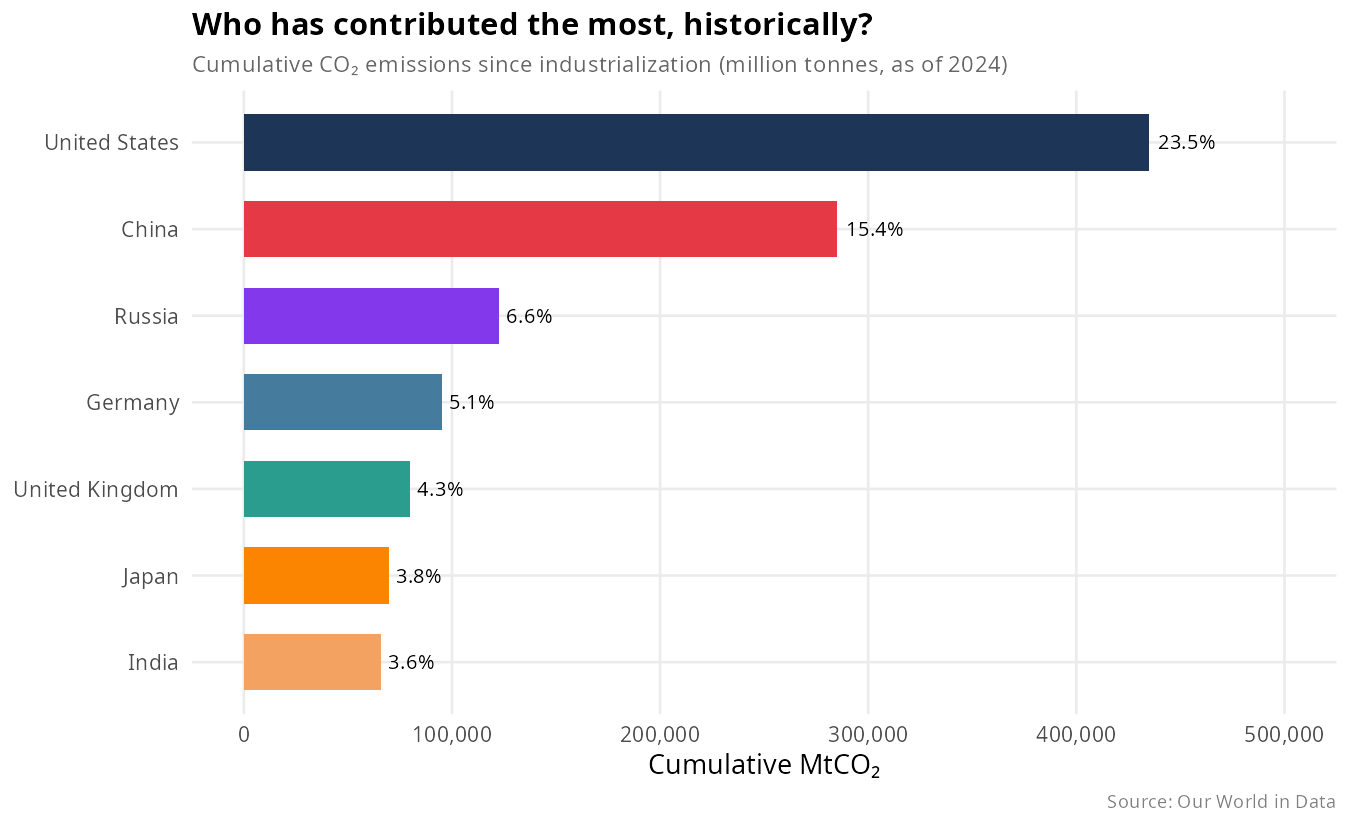
The US accounts for ~23.5% of all historical emissions — the foundation of the historical responsibility argument made by developing nations.
Lens 04 · Consumption
The US and UK’s apparent domestic progress is partly an artifact of offshoring production, not genuine decarbonization.
What we had to work around
What we learned
“The data cannot tell us what is fair. But it can tell us who has benefited most from the way responsibility has historically been measured — and who has not.”
Live Demo
Opening section — card reveal
Lens 3 — cumulative emissions
[https://pages.github.coecis.cornell.edu/info3312-sp26/proj-02-soft-blankets/]