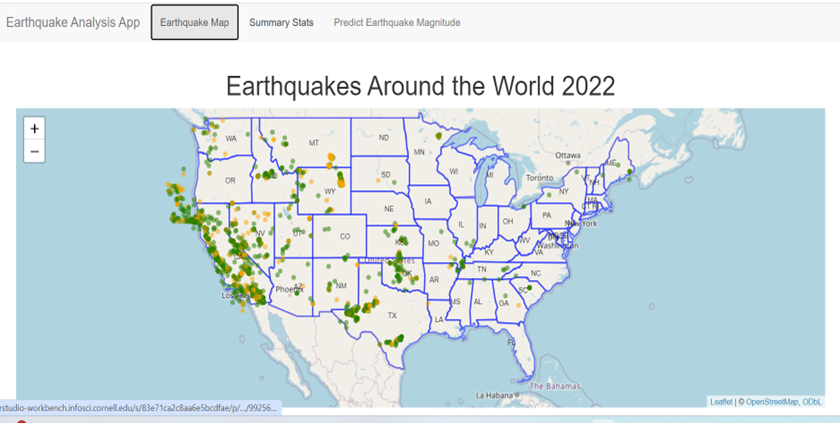
# A tibble: 5 × 2
  country       count
  <chr>         <int>
1 United States  7972
2 Indonesia      1569
3 Puerto Rico    1412
4 Japan           974
5 Philippines 753Earthquake Damages
2023-12-09
Introduce the topic and motivation
Topic: Explore the occurrence of earthquakes in the US and globally and examine the relationship between the time, location, and magnitude of earthquakes that have taken place in the 2022 worldwide.
Motivation: Earthquake is one of the most devastating natural disasters on this planet, destroying properties and ending lives. It is important to understand how many earthquakes are happening each month and how powerful they are. Investigating the proposed question will allow us to have a better understanding of how earthquakes are influencing our lives.
Inference/modeling/other analysis
# A tibble: 1 × 8
   mtry min_n .metric .estimator  mean     n std_err .config
  <int> <int> <chr>   <chr>      <dbl> <int>   <dbl> <chr>
1     3    20 roc_auc hand_till  0.855    10 0.00355 Preprocessor1_Model06
Comparing to the null model (roc_auc = 0.5) and navie bayes (roc_auc = 0.7819), random forest out-performs other models
Therefore it’s selected as our classification model for used to predict earthquake damages in our app
Overfitting: train_auc (0.9868) > test_auc (0.8592)
Random Forest Confusion Matrix 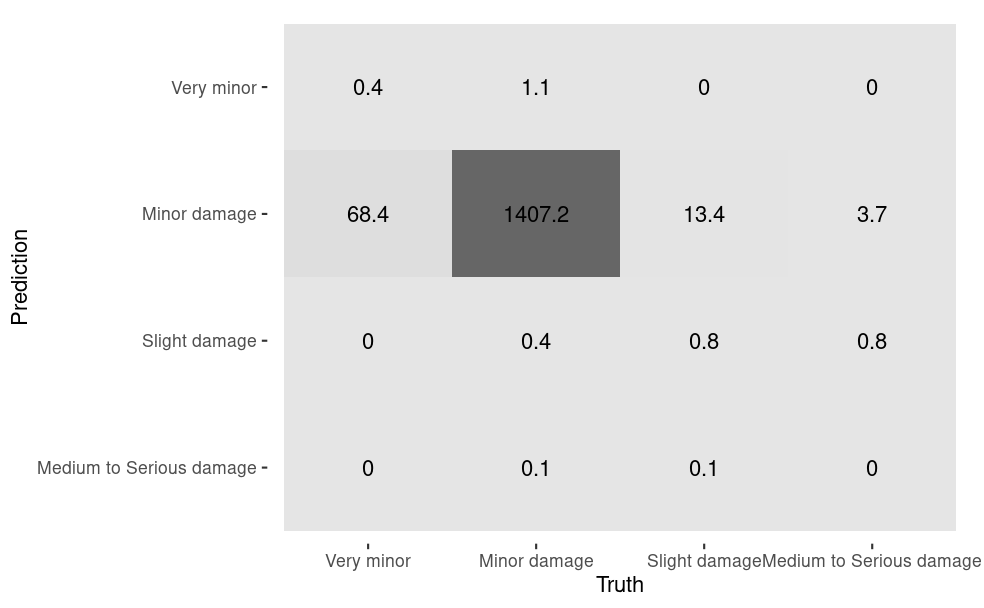
Inference/modeling/other analysis
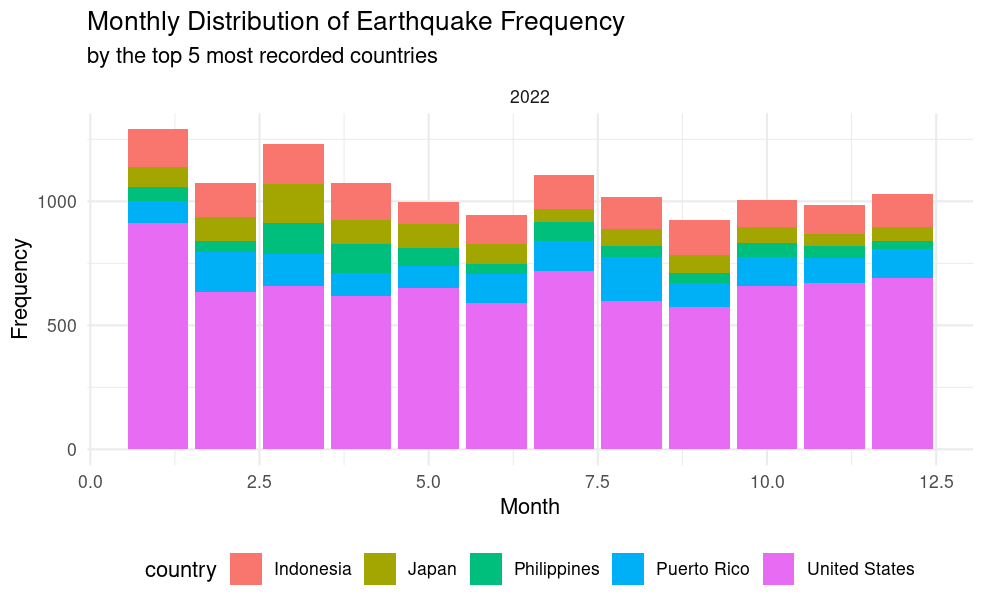
- The variation of earthquake occurrence throughout the year of 2022 is small
- This explains why the prediction model has little or no change when we input a different month (Access App)
Conclusions + future work

Conclusions
- There’s no strong correlation between location, time, magnitude, and frequency of earthquakes around the world.
Future Work
More data
Visualizations
- More user-controlled interactions
Modeling
Experiment with more models
Use more input variables