── Attaching packages ─────────────────────────────────────── tidyverse 1.3.2 ──
✔ ggplot2 3.4.2     ✔ purrr   1.0.0
✔ tibble  3.2.1     ✔ dplyr   1.1.2
✔ tidyr   1.2.1     ✔ stringr 1.5.0
✔ readr   2.1.3     ✔ forcats 0.5.2
── Conflicts ────────────────────────────────────────── tidyverse_conflicts() ──
✖ dplyr::filter() masks stats::filter()
✖ dplyr::lag()    masks stats::lag()

Attaching package: 'rvest'


The following object is masked from 'package:readr':

    guess_encoding


Attaching package: 'scales'


The following object is masked from 'package:purrr':

    discard


The following object is masked from 'package:readr':

    col_factor


── Attaching packages ────────────────────────────────────── tidymodels 1.0.0 ──

✔ broom        1.0.2     ✔ rsample      1.1.1
✔ dials        1.1.0     ✔ tune         1.1.1
✔ infer        1.0.4     ✔ workflows    1.1.2
✔ modeldata    1.0.1     ✔ workflowsets 1.0.0
✔ parsnip      1.0.3     ✔ yardstick    1.1.0
✔ recipes      1.0.6

── Conflicts ───────────────────────────────────────── tidymodels_conflicts() ──
✖ scales::discard() masks purrr::discard()
✖ dplyr::filter()   masks stats::filter()
✖ recipes::fixed()  masks stringr::fixed()
✖ dplyr::lag()      masks stats::lag()
✖ yardstick::spec() masks readr::spec()
✖ recipes::step()   masks stats::step()
• Learn how to get started at https://www.tidymodels.org/start/


Attaching package: 'dsbox'


The following object is masked from 'package:infer':

gssFactors Affecting Countries’ UNSC Reelection Potential
Introduce the topic and motivation
- United Nations Security Council ensures international peace and security.
- Our project examines the relationship between key economic indicators and political stability using the World Bank’s World Development Indicators data set.
Does GDP, military expenses, and mortality rate affect a country’s ability to be reelected four or more times?
We explore any correlations between economic indicators and political stability.
- Our findings could inform decisions about economic development and political stability.
Introduce the data
- Research Question: What Factors Contribute to UNSC Re-Election?
- Data: World Bank, 91 Countries, 25 Columns, 65 observations
- Criteria For Analysis: Non-Permanent Members, Elected ≥ 4 Vs Elected < 4
- Region of Interest: W Europe: 2 vs 11, E Europe: 1 vs 9, Latin: 6 vs 9, Africa/Asia: 7 vs 36
- Observations of Interest: GDP, Military Exp, Mortality Rate
- Time Period of Interest: 2000-2020
Highlights from EDA
- We have formed a clear research question about the non-permanent UN security council members that narrows down to countries of interest that has been re-elected four or more times between 2000-2020
- We had thorough documentation of the data collection, cleaning and description
- Our interpretation of the data was difficult due to a lack of visualization. Solution to visualization: bar plot
Inference/modeling/other analysis
Conclusions
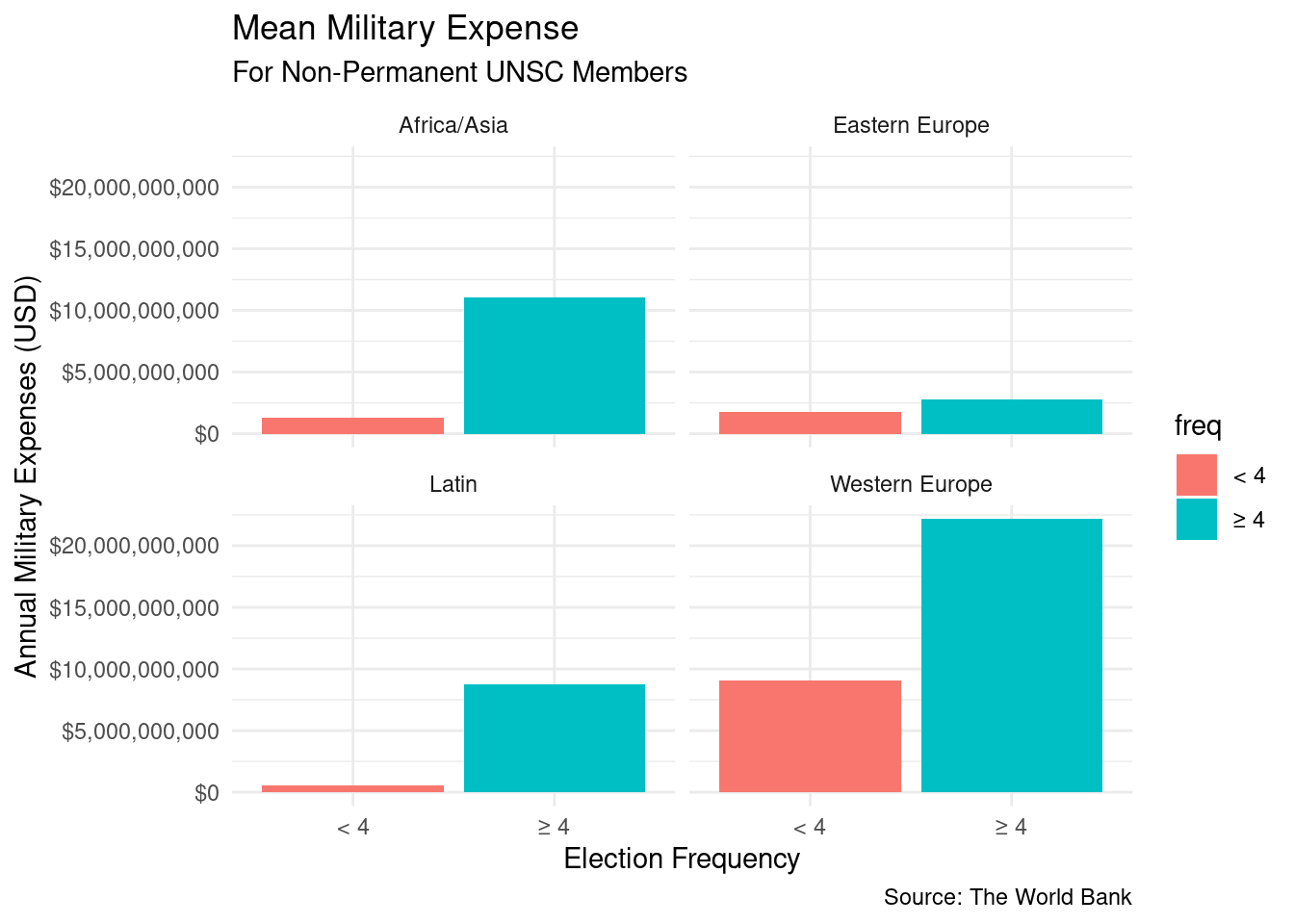
In conclusion, our analysis demonstrates a significant correlation between GDP, military expenditure, and a country’s likelihood of being reelected to the UN Security Council. We observed that countries with higher GDPs and higher military expenditures have a greater chance of reelection. However, no statistically significant relationship was found between mortality rates and reelection frequency.
Future Work
Analyze Voting Patterns: Examine the voting system to determine if alliances or diplomatic relations affect voting patterns within the UN Security Council elections.
Conduct Case Studies: Investigate the specific circumstances and factors at play in countries like Japan, which, according to our analysis, has the highest mean GDP and has been reelected 12 times