Case Study
Case study: comparing offensive style
This page takes the shot-quality ideas from the homepage and applies them to actual teams and players. Instead of just asking who had more shots or goals, we look at what kind of offense each team created. Were they throwing a lot of pucks at the net? Getting into dangerous areas? Living on the perimeter? Creating chances from the middle of the ice?
We focus on the Colorado Avalanche (ranked No.1 in the league) and Vancouver Canucks (ranked last in the league) because they make the league-wide patterns easier to see. Looking at two teams helps the analysis focus on: where each team’s chances came from, how dangerous those chances were, and which players were doing most of the work.
Avalanches vs Canucks
1. Avalanches create danger closer to the net
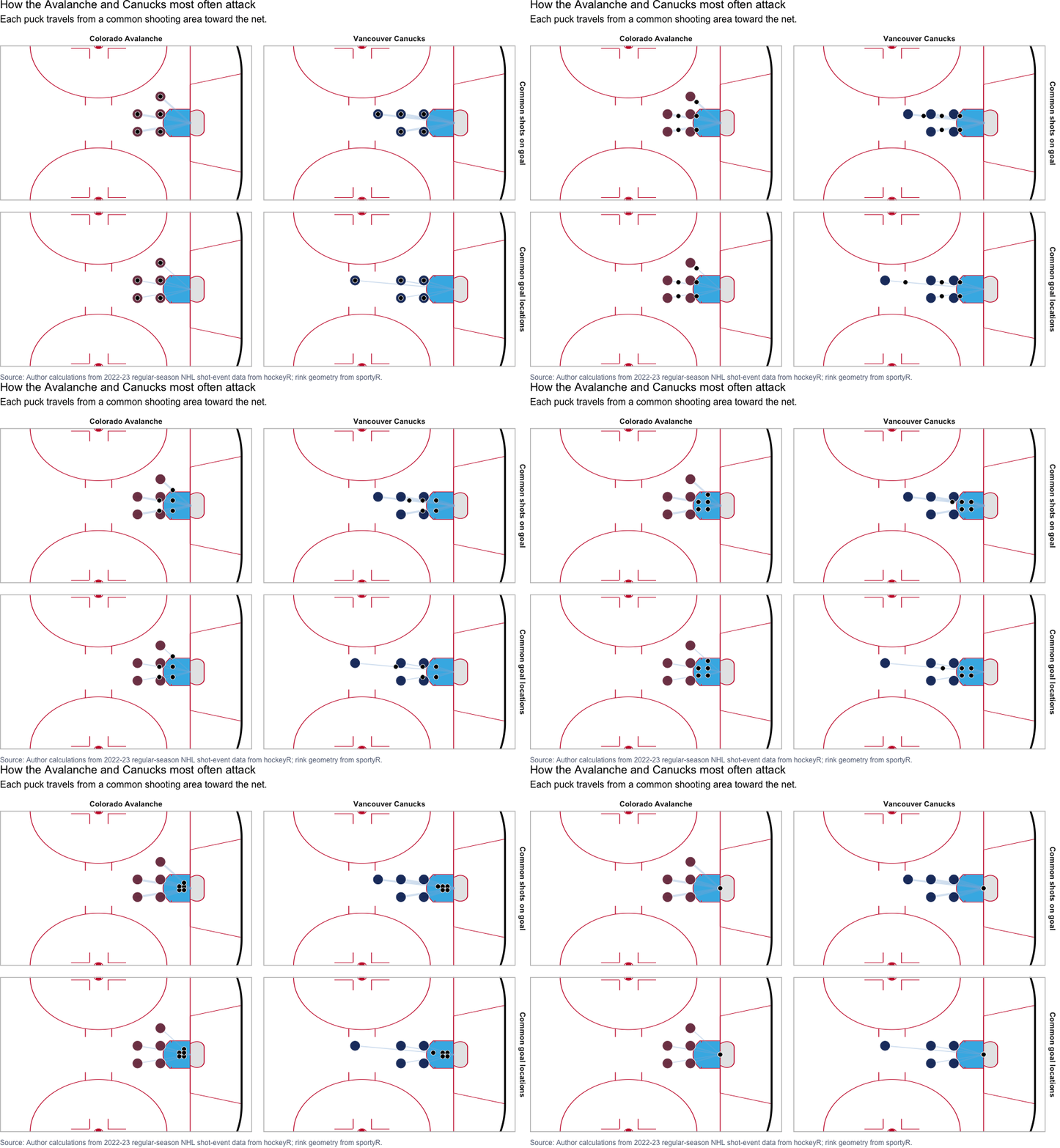
Some of the inferences that we can make from this gganimated graph are that the Colorado Avalanches tend to have closer shot locations to their goal locations in comparison to the Vancouver Canucks which reveal variance across how likely they are to make a goal from nearby. This could suggest that the Avalanches are typically more precise and accurate when taking their shots, while the Vancouver Canucks may rely on luck or potential openings rather than precision and accuracy when shooting from a further distance, as we can observe in the bottom right graph.
Additional note: The black moving dot is a hockey puck, and the colored dots are player positions by common shot on goal vs. common goal locations
2. Star players shape each team’s offensive profile
When we hover over this graph, we can observe how Mikko Rantenen (Avalanche) and Nathan MacKinnon (Avlanche) land significantly more shots on their goals (294 and 360 respectively) at roughly 8-9% danger during shots in comparison to J T Miller (Canucks) and Elias Petterson (Canucks) (218 and 254 respectively), which ultimately factors into how the team will do overall. It is also important to note that even though Nathan has 360 shots on goals, his average danger per shot is ~7.6%, suggesting that he may also be implementing more strategy as the main shooter in comparison to Elias. Just through analyzing this graph, we can see that the Colorado Avalanche team has significantly higher odds of shooting goals, despite taking them in relatively the same amount of danger, suggesting that they implement better strategy and expertise during their games.
Limitations
One limitation of this case study is that it focuses on shot-event data, so it does not capture everything that happens before a shot is taken. A team’s offensive strategy also depends on passing sequences, puck movement, defensive pressure, zone entries, rebounds, screens, and goalie positioning, but many of those details are not fully visible in this dataset. Because of that, we should be careful not to say that one team is simply “more skilled” or “less strategic” based only on shot location and xG. The graphs show patterns in chance creation, but they do not explain every reason those patterns happen.
Another limitation is that this comparison looks at one regular season and focuses on two teams. The Avalanche and Canucks are useful because they represent very different performance levels, but their results may also reflect injuries, roster construction, coaching systems, or game context during that season. Expected goals is a helpful metric for comparing shot quality, but it is still a model-based estimate rather than a perfect measure of offensive ability. So, the takeaway is not that xG tells the whole story, but that it gives us a stronger starting point than shot count alone.
Case study takeaway
The Avalanche–Canucks comparison is a good example of why hockey offense is about more than just “getting pucks on net.” On the surface, both teams are taking shots and creating offensive activity, but the quality of those chances looks very different. Colorado’s attack appears more concentrated around dangerous areas near the net, where shots are more likely to become goals. Vancouver, on the other hand, shows more separation between where shots are commonly taken and where goals actually happen, suggesting that their offense may rely more on less consistent chances, rebounds, or openings that are harder to recreate.
The player-level view makes this difference even clearer. For the Avalanche, players like Mikko Rantanen and Nathan MacKinnon are not only taking a lot of shots, but they are also helping drive meaningful chance creation. That combination matters because high-volume shooters are most valuable when they can still create dangerous looks, not just fire from anywhere. The Canucks also have important offensive players, including J.T. Miller and Elias Pettersson, but their profiles suggest a different kind of attack: one that may depend more on individual moments rather than a consistently dangerous team-wide shot pattern.
This is exactly the point of our visual story. A team can look active in a box score and still struggle if its shots are coming from lower-danger areas. By comparing a top team like the Avalanche with a weaker-performing team like the Canucks, we can see how expected goals, rink location, and player shooting profiles help explain performance in a way that raw shot totals cannot. In other words, dangerous offense is about creating the kinds of chances that are actually likely to become goals.